top of page

C/O Futures Terrorism Research Note Series

C/O Futures AI Initiatives

Robert J. Bunker, Kaden K. Bunker, and Pamela Ligouri Bunker

30 August 2026


From early 2025 into mid-2026, an initial sequence of active shooter and extremist attacks and plots have taken place within the United States and Canada which have utilized generative artificial intelligence (GEN AI) to enhance their lethality potentials. GEN AI has been used to facilitate improvised explosive device (IED) construction; for intelligence, surveillance, and reconnaissance (ISR); for guidance on how to properly utilize small arms; and for mission planning purposes in support of an attack. The use of GEN AI for nefarious purposes has been better recognized pertaining to terrorist groups as it relates to Islamic State operational components in Afghanistan-Pakistan, the Middle East, and in Western Africa—and to a lesser extent Al Qaeda whose use has been more experimental in nature.[1] GEN AI usage is also now appearing in support of basic criminality connected to bank robbery, arson, and premeditated homicide planning. The projection is that GEN AI (and later agentic AI) utilization will become increasingly more common in North American future active shooter and extremist incidents and plots given the indications and warning (I&W) now evident.


Key Findings


  • Six incidents or disrupted plots involving generative AI and active shooter or extremist activity were identified in the United States and Canada between January 2025 and August 2026.

  • The cases show GEN AI being used or implicated in intelligence, surveillance, and reconnaissance (ISR); mission planning; improvised explosive device-related research; and firearms-related information.

  • The incidents occurred in Las Vegas, New Orleans, Tallahassee, Palm Springs, Tumbler Ridge, and Montréal.

  • Although the number of cases remains small, C/O Futures assesses that they represent a developing indications and warning (I&W) pattern rather than isolated anomalies.

  • As generative AI matures and agentic AI becomes more widely available, these technologies are expected to provide violent actors with increasingly capable tools for planning, reconnaissance, attack preparation, and related operational support.

  • Related criminal uses of GEN AI outside ideological extremism suggest that tactics and lessons may diffuse between ordinary criminal and extremist use cases.


Indications & Warning


C/O Futures assesses that consumer generative artificial intelligence is beginning to move from experimentation into practical use by violent non-state actors. Terrorist organizations overseas have already demonstrated early adoption, while cases since January 2025 indicate that similar capabilities are now appearing in North American active shooter and extremist incidents and plots.


Although the number of identified incidents remains small, the emerging pattern provides indications and warning of increasing GEN AI—and eventually agentic AI—use to support planning, reconnaissance, attack preparation, and other operational needs.


Incident Overview


Las Vegas, Nevada — 1 January 2025


Generative AI was used in connection with planning surrounding the Trump International Hotel Cybertruck explosion, including explosive-related research and other preparatory information.


New Orleans, Louisiana — 1 January 2025


AI-enabled Meta glasses were used during pre-attack reconnaissance of the Bourbon Street target area.


Tallahassee, Florida — 17 April 2025


ChatGPT interactions were associated with tactical questions, firearms-related information, and mission-planning activity prior to the Florida State University attack.


Palm Springs, California — 17 May 2025


Authorities reported that a generative AI chatbot was used in research related to explosives and detonation in connection with the fertility-clinic bombing.


Tumbler Ridge, British Columbia — 10 February 2026


Prior ChatGPT conversations involving violent and firearms-related scenarios became part of the post-incident examination of the school shooting.


Montréal, Quebec — 21 August 2026


Canadian authorities disrupted an alleged school attack plot in which artificial intelligence was reportedly used in potential attack planning.


C/O Futures Analysis


The emerging North American cases suggest that generative artificial intelligence is beginning to augment the operational capabilities of active shooters, extremists, and other violent non-state actors rather than creating an entirely new category of threat. This pattern is also consistent with broader adoption already observed among terrorist and other violent actor networks.


The principal concern is not that GEN AI creates entirely new threat categories, but that it can strengthen established capabilities. Identified applications include support for intelligence, surveillance, and reconnaissance; improvised explosive device-related research; small-arms information; mission planning; and potentially operational security, escape and evasion, and attack livestreaming.


As generative AI matures—and as agentic AI systems become more capable and accessible—C/O Futures expects these technologies to increasingly amplify the effectiveness, planning quality, and narrative impact of active shooter and extremist attacks.


Cover of C/O Futures research on generative AI use for ISR, mission planning, and IED creation by active shooters and extremists.


Related C/O Futures Research


C/O Futures Terrorism Subject Bibliography — January 2025


Limited Distribution OSINT Product — October 2024


Work With C/O Futures


C/O Futures provides specialized research, threat analysis, intelligence support, briefings, red teaming, and training related to emerging threats, adversarial technologies, and evolving operational environments.


Follow C/O Futures Research


Receive newly published C/O Futures research notes and analyses by email.


C/O Futures Terrorism Research Note Series

Active (Mass Shooter) Response

Lisa J. Campbell and Pamela Ligouri Bunker

22 July 2026


On 18 May 2026, teenagers Cain Clark and Caleb Vazquez carried out an active shooter attack at the San Diego Islamic Center, targeting adults and children from an adjacent Muslim school who were worshipping at the center’s Mosque. Unusual in that there were two perpetrators, the attack continues an emerging global trend of non-white White Supremacist/neo-Nazi violence. Both attackers left manifestos explaining their motivation for the shooting including—among a variety of related narratives—a response to ‘The Great Replacement,” a common far right conspiracy theory. Notably, the attack was live-streamed, emulating that of mass-shooter Brenton Tarrant, and the manifesto includes reference to “The Sons of Tarrant.” Significantly, still photos from the live-stream show that their gear and weapons contained text and symbology—another emerging trend among active shooters.


C/O Futures Terrorism Research Note Series


Lisa J. Campbell and Robert J. Bunker


16 July 2026


Flamethrowers Are Emerging in Violent Extremist and Criminal Arsenals


A series of incidents in the United States and Mexico is raising an emerging security concern: commercial and improvised flamethrowers are appearing in the possession of violent extremists, radicalized individuals, and criminal organizations.


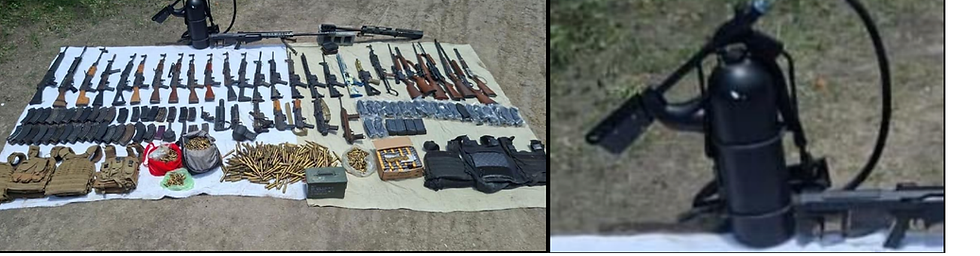
Recent cases examined by C/O Futures include flamethrowers recovered following an attempted attack on critical infrastructure near Las Vegas, a makeshift flamethrower used during the June 2025 attack in Boulder, Colorado, two flamethrowers recovered from an armed individual outside a North Carolina church, and a commercial flamethrower seized with a weapons cache in cartel territory in Tamaulipas, Mexico.


C/O Futures assesses these incidents as early-warning indicators of a broader threat trajectory.


Flamethrowers combine destructive incendiary capability with an unusually strong psychological effect. Their visual impact, potential to generate panic, and ability to attract extensive media attention may make them particularly appealing to violent actors seeking not only physical effects but also psychological and propaganda effects.


Key Findings

  • Flamethrowers have appeared across several recent extremist, criminal, and concerning security incidents, including cases in Colorado, Nevada, North Carolina, and Tamaulipas, Mexico.

  • The June 2025 Boulder attack demonstrated actual use of a makeshift flamethrower alongside Molotov cocktails during an attack against a public gathering.

  • Two commercial flamethrowers were recovered in connection with the February 2026 attempted attack against a Los Angeles Department of Water and Power substation near Searchlight, Nevada, although they were not used during the incident.

  • In June 2026, police arrested an armed man outside a High Point, North Carolina church and recovered two flamethrowers along with crossbows, ammunition, knives, body armor, and a notebook containing addresses of churches, schools, and public buildings. The flamethrowers were not used and their intended purpose remained undetermined.

  • Also in June 2026, Mexican military personnel recovered a commercial flamethrower from a weapons cache in Grupo Escorpiones territory in Tamaulipas, demonstrating the technology's appearance within the Mexican criminal environment.

  • C/O Futures identifies accessibility, commercial availability, online visibility, psychological impact, and the dual-use nature of flamethrowers as factors warranting increased threat awareness.


Why This Matters


The concern surrounding flamethrowers extends beyond their ability to start fires.


Historically, flame weapons have produced both physical and psychological effects. Their use in warfare has included attacks against personnel, infrastructure, fortified positions, vegetation, and other targets, while their visual and psychological characteristics have contributed to their fear-inducing reputation.


Those characteristics may have particular relevance in a violent extremist context.


An extremist seeking publicity or mass panic does not necessarily need a weapon to be more effective than conventional firearms for it to have value. The dramatic visual character of fire, its ability to generate fear, and the potential for imagery of an attack to spread rapidly through traditional and social media may make flame weapons attractive as what the research note describes as “terror weapons.”


The emerging issue is therefore not simply whether flamethrowers become common weapons.


It is whether their availability, visibility, psychological impact, and appearance across several different threat environments begin to make them attractive to a wider range of violent actors.


Four Recent Incidents Form an Early-Warning Pattern


The C/O Futures research note identifies four recent cases as particularly significant.


Boulder, Colorado — June 2025


In June 2025, an attacker used a makeshift flamethrower and Molotov cocktails against participants in a demonstration in Boulder, Colorado.


Law enforcement reporting cited in the research note stated that the attacker had additional incendiary devices and had planned the attack in advance.


Unlike the other recent cases examined in the report, this incident demonstrated the actual employment of an improvised flame weapon against people.


Imagery reproduced in the C/O Futures research note shows the Boulder attacker carrying the makeshift flamethrower and, subsequently, after the device had been removed.


Searchlight, Nevada — February 2026


C/O Futures previously examined the February 2026 attempted attack against a Los Angeles Department of Water and Power substation near Searchlight, Nevada.


Investigators recovered two commercial flamethrowers along with thermite and other weapons and materials associated with the incident.


The flamethrowers were not used, and their intended role remains undetermined. Their presence nevertheless adds to the broader pattern of flame weapons appearing within concerning extremist-related arsenals.


High Point, North Carolina — June 2026


On 28 June 2026, authorities arrested an armed man outside Wesley Memorial Church in High Point, North Carolina.


According to reporting cited by C/O Futures, investigators recovered two flamethrowers, two crossbows, more than 500 rounds of ammunition, knives, body armor, and other items.


Authorities also reportedly recovered a notebook containing addresses of churches, schools, and public buildings.


The flamethrowers were not used, and the research note states that their intended purpose was undetermined.


The incident is nevertheless significant from an indications-and-warning perspective because of the location, accompanying equipment, and presence of multiple flame weapons.


Tamaulipas, Mexico — June 2026


Just days before the North Carolina incident, Mexican military personnel reportedly recovered a commercial flamethrower alongside firearms, tactical equipment, and vehicles in Grupo Escorpiones territory in Matamoros, Tamaulipas.


The research note identifies the incident as another indication of flamethrowers appearing outside their conventional commercial applications and within the broader criminal weapons environment.


Commercial Availability Changes the Threat Environment


One of the most important elements of this emerging threat is that flamethrowers are no longer confined to historical military systems.


Commercial flame-producing systems are marketed in the United States for legitimate applications including agricultural burns, vegetation management, snow and ice removal, pyrotechnics, firefighting and training, and other specialized purposes.


At the federal level, flamethrowers are generally not treated as firearms, although state and local restrictions vary.


The C/O Futures research note documents a range of commercially available systems and demonstrates how the technology has expanded beyond traditional backpack-style equipment into smaller systems and remotely operated platforms.


For threat analysts, the important issue is not the legitimate commercial market itself.


It is the possibility that widely available dual-use technology can be repurposed by violent actors.


From Arson to a Distinctive “Terror Weapon”


Fire is not a new extremist tactic.


C/O Futures' research identifies historical examples in which terrorist organizations have incorporated arson and incendiary effects into larger attacks, including the 2008 Mumbai attacks, the 2012 Benghazi attack, and the 2024 Islamic State in Khorasan Province attack against Crocus City Hall outside Moscow.


What may be changing is the form in which incendiary capability is available to individual actors.


Commercial and improvised flamethrowers provide a highly visible means of projecting fire that is psychologically distinct from conventional arson.


For violent extremists interested in spectacle, fear, propaganda, or media attention, that distinction matters.


C/O Futures Threat Assessment


C/O Futures assesses that the convergence of several trends warrants increased attention.


Commercial flamethrowers have become more visible to consumers. Improvised systems have also appeared online. At the same time, recent incidents demonstrate that flame weapons are appearing across multiple threat environments rather than within one ideological or criminal category alone.


The four principal cases examined in the research note span different circumstances: the Boulder attack, the Searchlight critical-infrastructure incident, the High Point church arrest, and the cartel-associated weapons seizure in Tamaulipas.


That diversity is itself an important warning indicator.


It suggests that flamethrower interest should not be monitored solely through the lens of one extremist ideology or one type of criminal organization.


Implications for Law Enforcement, Homeland Security, and Critical Infrastructure


For law enforcement and security professionals, the primary value of identifying this trend early is preparedness.


A flamethrower appearing during an investigation, threat assessment, suspicious-person encounter, weapons seizure, or pre-attack interdiction should not automatically be dismissed as an eccentric novelty item.


Context matters.


Its significance may change considerably when it appears alongside body armor, firearms, incendiary materials, extremist writings, target lists, reconnaissance information, critical-infrastructure targeting, or other indicators of violent intent.


The report concludes that the combination of increased availability, online awareness, technological development, and the recent cluster of incidents warrants greater awareness and preparation for potential future events involving flame weapons.


Indications & Warning


The purpose of this research is not to suggest that flamethrowers have become a common extremist weapon.


They have not.


Rather, the recent incidents may represent an early-warning stage in the adoption of an unconventional weapon type.


The significance lies in recognizing the trajectory before such weapons become more established within violent extremist or criminal arsenals.


For intelligence analysts, law enforcement personnel, homeland security professionals, critical-infrastructure security teams, and other practitioners, continued monitoring of flamethrower acquisition, possession, extremist interest, and association with other pre-attack indicators is warranted.


Download the Full C/O Futures Research Note


The complete C/O Futures Terrorism Research Note provides the full analysis underlying this early-warning assessment, including the incident case studies, historical context, imagery, commercial technology overview, comparative tables, references, and additional analysis.


Related C/O Futures Research


This C/O Futures Terrorism Research Note examines the February 2026 attempted attack against an LADWP power substation near Searchlight, Nevada, including the recovery of commercial flamethrowers, thermite, firearms, and other materials. It provides additional context for one of the principal incidents examined in this early-warning assessment.


This C/O Futures Terrorism Research Note examines the March 2024 Crocus City Hall attack and the combination of small-arms violence and arson TTPs, providing relevant background on the use of fire as part of contemporary terrorist attacks.


Work With C/O Futures


C/O Futures provides specialized research, threat analysis, intelligence support, briefings, red teaming, and training related to emerging threats, adversarial technologies, and evolving operational environments.


Follow C/O Futures Research


Receive newly published C/O Futures research notes and analyses by email.


© 2020-2026 by C/O Futures, LLC. All Rights Reserved.

bottom of page